

Protective Factors & Resilience
Protective factors are the conditions in families and communities that, when present, reduce risk and promote healthy outcomes. The Strengthening Families framework identifies five core protective factors:
Parental/caregiver resilience
Social connections
Knowledge of parenting and child development
Concrete support in times of need
Social and emotional competence of children
Joining Forces for Children works at every level — individual, family, organizational, and community — to strengthen these factors.
Resilience: our brains are malleable
Resilience is the ability to thrive, adapt, and cope despite tough and stressful times, and is an ideal counterbalance to ACEs.6
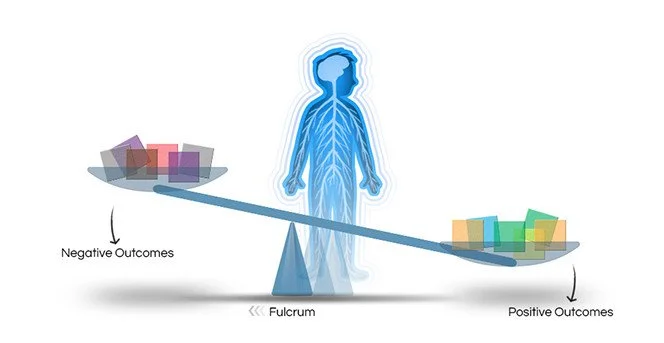
Resilience tips the scale toward healthy
According to the Center on the Developing Child at Harvard University, one way to understand the development of resilience is to visualize a balance scale. Protective experiences and coping skills on one side counterbalance significant adversity on the other. Resilience is evident when a child’s health and development tips toward positive outcomes — even when a heavy load of factors is stacked on the negative outcome side.
Seven core ideas to help develop and foster resilience in children:
Competence – Building their understanding of their skills.
Confidence – Helping kids grow a true belief in their own abilities.
Connection – Connecting children with other people, schools and communities to further build their support system.
Character – Helping them comprehend a clear sense of right and wrong, and teaching them moral values.
Contribution – Offering children a chance to contribute to the well-being of others. They learn that giving service feels good and then feel more confident to ask others for help as well.
Coping – Discovering a variety of healthy coping strategies to prevent children from dangerous “quick fixes” to stress.
Control – Teaching children to make decisions on their own so they can experience a sense of control.
To explore these 7Cs in more detail, click here.
Additional ways to promote resilience:
Acknowledge the child’s experience of ACEs and how it may be influencing their behavior – reframing “What’s wrong with you?” to “What happened to you?”
Help children identify their emotions, talk about them, and express them appropriately.
Empower children to problem solve and work through their issue/problem.
Promote healthy coping habits of meditation and mindfulness, exercise, and sleep routines.
Build your understanding and empathy
When working with others who may have experienced ACEs, consider the following:
What ACEs have you possibly experienced?
How have ACEs impacted your life (physically, emotionally, professionally)?
What internal and external support helped you deal with your ACEs?
How have your ACEs impacted your ability (both positively and/or negatively) to help others as they cope with their own ACEs?
Working together to build better outcomes.
We all have a role to play in providing better futures for children. No matter where you live or who you are, you can play a role in building better outcomes. To learn more, explore our audience-specific guides below about how ACEs and fostering resilience can help change the future for children.



- Felitti, V.J., Anda, R.F., Nordenberg, D., Williamson, D.F., Spitz, A.M., Edwards, V., & Koss, M. P. (1998) Relationship of childhood abuse and household dysfunction to many of the leading causes of death in adults: The Adverse Childhood Experiences (ACE) Study. American journal of Preventive Medicine 14(4), 245-258
- Shonkoff, Jack P. Andrew S. Garner. “The Lifelong Effects of Early Childhood Adversity and Toxic Stress.” Pediatrics: Official Journal of the American Academy of Pediatrics. December 26, 2011.
- Shonkoff, Jack P. Andrew S. Garner. “The Lifelong Effects of Early Childhood Adversity and Toxic Stress.” Pediatrics: Official Journal of the American Academy of Pediatrics. December 26, 2011.
- http://www.rwjf.org
- Shonkoff, J. P. & Garner, A.S. (2012). The Lifelong Effects of Early Childhood Adversity and Toxic Stress. Pediatrics: Official Journal of the American Academy of Pediatrics, 129(1), e232–e246.
- Prevent Child Abuse America, KPJR Films. “The Facilitator’s Guide to Resilience.”
- Ginsburg, K. R., & Kinsman, S.B. (2014) Reaching Teens: Strength-based Communication Strategies to Build Resilience and Support Healthy Adolescent Development. American Academy of Pediatrics.